GoldenMeadow Pest DefenseGoldenMeadow Pest Defense

Termite Control Greenville

Termite pressure across Greenville County is driven largely by the eastern subterranean termite, an insect that nests deep beneath the surface and enters structures through hairline cracks in masonry. According to the…
Get My Estimate →(864) 215-5207
Termite Control in Greenville, SC in Greenville, SC
Quick answer
  • What is included: Full perimeter inspection of sill plates, crawlspaces, and foundation walls, followed by either liquid termiticide trenching or bait station placement.
  • How fast: Standard structural inspections take 60 to 90 minutes, with treatments typically executed within 24 to 48 hours of assessment.
  • What it costs: Targeted treatments begin at the $200 minimum baseline, with whole-home curative protocols ranging from $850 to $2,400 based on linear footage.
  • Target pests treated: Subterranean termites (Reticulitermes flavipes) and Formosan subterranean termites nesting in surrounding moist soils.
  • How to schedule: Call (864) 215-5207 to arrange an on-site property evaluation, with final pricing confirmed before treatment begins.

Termite pressure across Greenville County is driven largely by the eastern subterranean termite, an insect that nests deep beneath the surface and enters structures through hairline cracks in masonry. According to the Clemson University Cooperative Extension Service, our Piedmont region experiences significant reproductive swarms from March through May as soil temperatures cross 70 degrees Fahrenheit. Properties in historic districts like North Main, Overbrook, and Augusta Road frequently feature crawlspace foundations with original heart-pine framing that rests close to damp grade. When heavy rainfall events wash through the Reedy River basin, moisture levels elevate the risk of subterranean shelter tubes bridging masonry piers to reach untreated subfloors.

Effective defense requires understanding the interaction between local geology and chemical barriers. The high iron-oxide content of Upstate Cecil soil, documented by the USDA Natural Resources Conservation Service, creates dense red clay that binds differently with termiticides than sandy coastal soils. Applying liquid treatments requires deep rod injection and continuous soil trenching along foundation footings to establish a contiguous zone. For properties in Parkins Mill, Alta Vista, and Verdae built on monolithic concrete slabs, expansion joints and plumbing penetrations serve as primary intrusion highways. The US Environmental Protection Agency regulates non-repellent termiticides such as fipronil, which termites carry back to the central subterranean colony rather than avoiding, resulting in total colony elimination rather than superficial deterrence.

Property layout and foundation design dictate the choice between perimeter liquid treatments and baiting matrices. Monitored bait stations conform to guidelines established by the National Pest Management Association and represent an optimal choice for sloped parcels near sensitive watershed zones around Paris Mountain State Park, Cleveland Park, or The Cliffs Valley. Hexaflumuron or noviflumuron bait cartridges disrupt the molting cycle governed by insect chitin synthesis, as classified under the Insecticide Resistance Action Committee Mode of Action rules. While bait systems require ongoing monitoring visits, liquid barriers provide immediate residual protection in undisturbed soil. Homes in Gower Estates, Nicholtown, and Botany Woods with enclosed, humid crawlspaces often pair targeted exterior trenches with interior crawlspace moisture reduction to eliminate the fungal rot that accelerates subterranean wood consumption.

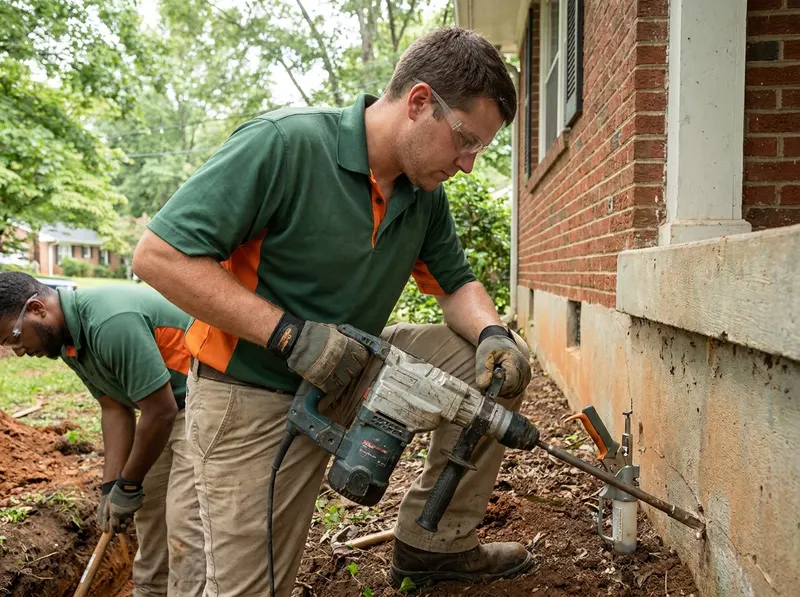
    Step 1: Technicians conduct a visual inspection of all accessible crawlspace floor joists, foundation walls, and perimeter expansion gaps using high-lumen detection lights. Step 2: The foundation perimeter is cleared of mulch and topsoil to expose raw earth against brick, stone, or poured concrete. Step 3: Crews dig continuous trenches measuring six inches wide by six inches deep directly adjacent to foundation footers, following safety procedures monitored by the Occupational Safety and Health Administration. Step 4: Technicians apply non-repellent liquid termiticide at a calibrated rate of four gallons per ten linear feet per foot of depth, or drill and anchor bait stations every ten to twelve feet around the drip line. Step 5: Treated soil is backfilled into the trench, and specialized monitoring logs are issued to the homeowner detailing structural clearance.

How much does Termite Control in Greenville, SC cost in Greenville?

Spot Treatment / Localized Pier Defense (Minimum Charge)$200 - $450
Standard Crawlspace Treatment (1,500 - 2,200 sq ft)$850 - $1,450
Full Slab Foundation Perimeter Liquid Barrier$950 - $1,650
Exterior Subterranean Baiting System Installation$1,100 - $1,800
Large Estate / Complex Foundation Defense (>3,000 sq ft)$1,750 - $2,400

Every job gets a firm, written price after an on-site visit.

Common questions

How does red clay soil affect termite control in Greenville?
Dense Piedmont red clay requires mechanical trenching and specialized rod injection because surface spraying cannot penetrate the tightly compacted clay particles around foundation footings.
What is the difference between swarmer ants and termites in Greenville?
Termite swarmers possess straight antennae, a uniform waist without constriction, and two pairs of equal-length wings, whereas reproductive ants have elbowed antennae, narrow pinched waists, and shorter hind wings.
Are termite treatments safe for household pets in Greenville yards?
Non-repellent liquid treatments bind tightly to soil organic matter and subsoil clay within hours, posing negligible exposure risk to domestic pets once the trench is backfilled and dried.
Do crawlspace moisture levels impact termite activity in Greenville homes?
Subterranean termites require continuous humidity to survive, making humid crawlspaces above 70 percent relative humidity prime targets for structural colonization through foundation entry points.
How often should homes in Greenville receive professional termite evaluations?
Annual structural inspections are recommended across Upstate South Carolina due to regional subterranean colony density and prolonged warm foraging seasons running from early spring through late autumn.

Get started today

Tell us about your termite control in greenville, sc job in Greenville and we'll send a clear, written quote, usually the same day.

Get your PEST CONTROL SEVICE quote, Greenville

We only use your ZIP to check availability, no spam.