Residential properties in Greenville encounter intense biting insect pressure driven by seasonal humidity and dense foliage cover. Homes nestled near established canopies like those bordering Paris Mountain State Park…
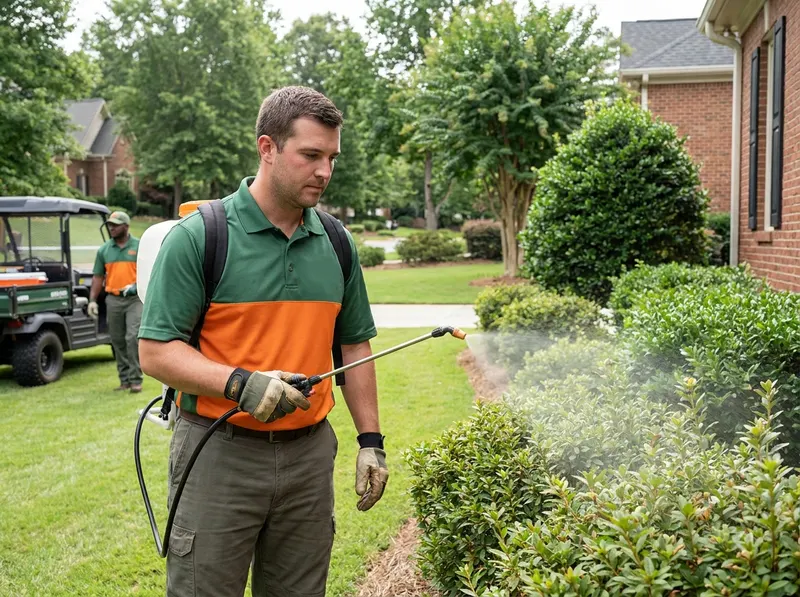
Residential properties in Greenville encounter intense biting insect pressure driven by seasonal humidity and dense foliage cover. Homes nestled near established canopies like those bordering Paris Mountain State Park, the Cleveland Park greenway, or the riparian zones of the Falls Park on the Reedy experience heavy swarms of invasive Asian tiger mosquitoes (Aedes albopictus). This daytime-biting species thrives in small water volumes rather than open lakes. Properties in North Main, Augusta Road, and Overbrook often feature mature hardwoods, ivy groundcover, and older clay-tile perimeter gutters that trap stagnant runoff. Scientific barrier defense targets the lower leaf canopies where adult insects harbor during the heat of the day, neutralizing them on contact while preserving pollinators that frequent upper flower blooms.
Effective intervention requires addressing both adult populations and subsurface larvae. A standard backpack mist blower treats the underside of broadleaf foliage up to 10 feet high, creating an electrostatic residual barrier that adheres to the plant tissue. Concurrently, biological control agents such as Bacillus thuringiensis israelensis (BTI), regulated under the EPA pesticide programs, are applied directly to non-draining standing water. According to vector management guidelines from the CDC Division of Vector-Borne Diseases, eliminating standing water smaller than a bottle cap removes the primary reproductive matrix. In neighborhoods like Gower Estates, Alta Vista, and Botany Woods, dense groundcover and decorative landscaping hold moisture in heavy Piedmont red-clay soil. The target trade-off centers on foliage density versus wind exposure: heavily wooded parcels in Parkins Mill or Verdae retain treatment efficacy longer than open turfgrass exposed to direct sunlight and heavy summer downpours.
Homeowners managing expansive terrain at The Cliffs Valley or tight urban lots in Nicholtown face differing exposure vectors. Large properties require strategic buffer zones established between wild underbrush and outdoor living zones, whereas urban parcels require strict boundary perimeter lines along property fencing to stop migrant populations. GoldenMeadow Pest Defense adheres strictly to structural perimeter defense standards supported by the Clemson University Department of Pesticide Regulation, which oversees certified pesticide applicator licensing throughout South Carolina. Furthermore, environmental application practices align with pollinator protection protocols established by the Pollinator Partnership and wildlife conservation benchmarks published by the South Carolina Department of Natural Resources. Every treatment is mapped to avoid non-target aquatic contamination as advised by the South Carolina Department of Public Health, securing the yard without relying on persistent synthetic compounds or multi-year contractual commitments. Step 1 begins with a comprehensive property drainage audit. Step 2 isolates and eliminates unmanaged standing water pockets. Step 3 introduces biological larvicide briquettes into essential retention areas. Step 4 applies the targeted micro-mist along the perimeter foliage canopy. Step 5 confirms barrier placement and outlines cultural maintenance steps for the property owner. For questions or scheduling an evaluation, call (864) 215-5207.
Every job gets a firm, written price after an on-site visit.
Tell us about your mosquito control job in Greenville and we'll send a clear, written quote, usually the same day.
 GoldenMeadow Pest Defense